Tuesday, July 12, 2011

7. Coraline


Gaiman, Neil.  Coraline. New York:  Harper Collins Children's Books, 2002. Print.

Annotation: 

I didn’t know I had another mother,” said Coraline cautiously.

Of course you do.  Everyone does,” said the other mother, her black button eyes gleaming.  After lunch I thought you might like to play in your room with the rats.”


Justification for Nomination:

 Neil Gaiman is a genius and a madman, both at the same time.  Gaiman is a fantastical storyteller, writing a creepy and dark fairy tale-esque story in Coraline.  I was immediately transported to Coraline’s dark and mysterious flat, with eccentric neighbors, talking and dancing rats, a sarcastic black cat, a place where spiders are eaten like popcorn by the “other parents,” and where lost souls float in and out and help Coraline along her quest.  Gaiman succeeds in writing a page turner, which is sure to capture (and keep!) the attention of young adults.  For these reasons and more, Coraline is definitely worthy of a nomination for the Mock Prinz Award.  Coraline is a story in which the “hero” (Coraline) battles evil (her creepy, white skinned, sewn-on buttoned eyed “other” mother).

In essence, Coraline is a curious young girl who has just moved into a flat with her parents.  Bored one day, Coraline goes exploring and discovers a doorway leading to another world.   In this “other” world, Coraline discovers she has “other” parents – grotesque versions of her real parents.  It is soon revealed that the other parents wish for Coraline to stay with them forever.  Coraline wants to return to her real life, but then learns the other parents have encapsulated her real parents in a snow globe.  In a quest to be able to see her parents again, Coraline is challenged to a “game” with her other mother -- if Coraline is able to find three souls (who are children trapped in the other world), then her parents will be set free, as will the three souls. However, if she fails to find all three souls, then she must remain in the other world with her other parents forever, never to see her real parents again. Coraline goes on a freight-filled journey of finding her parents.  Remaining brave, Coraline reassures herself over and over: “I’m brave, I’m not afraid” and “as she thought it, she knew it to be true.”

In the end, Coraline fearlessly rises to the occasion of successfully completing her quest.  Coraline’s empowerment of saving her parents fuels her courageousness and strength when she was scared and wanted to give up. 

(As a side note, Gaiman’s Coraline contains a few sketches throughout the book to give the reader a visual to the flat where Coraline lives, or to what the other parents, dancing rats and Coraline looks like.  I read the Coraline graphic novel version first, not realizing there was Gaiman’s book out there.  I ended up getting Gaiman’s original version.  In reading both, there were passages from the book which were word-for-word in the graphic novel.  The graphic novel did a great job of capturing details in the original book.  The illustrations in the graphic novel version were absolutely amazing.  They were vivid and colorful, but also disgustingly gross and scary.)

Genre Category: Fantasy, Coming of Age, Graphic Novel

Tuesday, July 5, 2011

6. Madapple

Meldrum, Christina. Madapple. New York: Borzoi Book by Alfred A. Knopf, 2008. Print.

Annotation:

“When I was growing up, Mother called the weed a variety of names.  Madapple at times.  Devil’s apple at times.  And green dragon and stinkwort and angel’s trumpet.  No matter, her warning was always the same: deadly.”

Justification for Rejection:

Christina Meldrum’s Madapple is an extremely powerful, thought provoking, intellectually written and complex story.  The story revolves around Aslaug, a 16-year-old, who has lived her life being home schooled and isolated from the outside world by her mother, Marin.  Marin teaches Aslaug about plants and their medicinal purposes.  Aslaug is taught more about nature and plants than she is about the outside world.  When Aslaug’s mother dies, Aslaug is accused of her murder (and later of the deaths of her aunt and cousin).  The plotline switches between current day while Aslaug is on trial and flashes back to Aslaug’s life with her mother, prior to her death.  Aslaug narrates the story dealing firsthand with her life with her mother, while the trial sequences are written as if torn from the transcripts of a real-life trial.  The story takes a turn when Aslaug finds out she does not have a father.  Rather, her mother had Aslaug by way of an immaculate conception.  Themes of virgin births, Christianity and questioning its beliefs, human nature, nature, botany, and science are all running themes throughout Madapple.

Meldrum writes an extremely smart and detailed novel.  There are areas of the book where I lost interest and became quite confused, but then Meldrum would draw me back in with her suspense and foreshadowing.  Through the confusion and the mundane parts, the story ties up nicely in the end.  In hindsight, I’m able to appreciate the book as a whole after reaching the end.  It was rough getting there though, I must say.  Meldrum’s characters are very well thought out and well rounded.  Some of the characters are unlikable.  While that may be so, they still provide a depth to the story.  I think many young adolescents may grow tired of Meldrum’s detailed writings of plants and long explanations dealing with religion.  Madapple may be better suited for older teens to adults instead.  There is no doubt in my mind that others will find this book intriguing and unique. 

Despite all this, however, I do not think Madapple is deemed worthy of a nomination for the Mock Prinz Award for it does not meet the qualifications of a young adult novel.  First, the developmental themes in Madapple do not involve the themes generally associated with YA literature -- revenge, popularity, getting a guy, or attaining beauty, just to name a few.  It is actually hard to determine exactly what the developmental themes are.  Some may argue that Aslaug is striving to figure out who she is.  Sure, she does not have a father – literally, does not have a father – but this being  in the supernatural genre, Aslaug is not particularly concerned about that.   

Second, while Aslaug is an absolute social misfit, like the uncertainly of not knowing who, or if, she has a father, it doesn’t affect her.  She doesn’t mind that she is different.  She is not sitting at home on a Saturday night, wondering “hmm, I wonder who my father is” or “why didn’t so-and-so ask me to the Prom.”   Rather, she doesn’t realize she’s a social misfit until after her mother dies and she’s forced into the modern world.  And even then, it’s not particularly at the top of her list to ingratiate herself into society.

Third, Aslaug is not presented as a confused teen.  As stated above, she lives a very sheltered, simple, isolated life with her mother.  She knows nothing otherwise.  That’s been her life for 16 years.  Lastly, it was difficult for me to be able to relate to any of the characters, let alone imagine a young adolescent finding some semblance in any situation and/or character.  To be considered as a YA nominee, I want to be able to relate and see myself or my former teen self in a character or a situation. 

Madapple is one of those examples of a good book, but not a great book. 

Genre Category:  Supernatural, Multicultural, Mystery

Tuesday, June 28, 2011

5. Homeless Bird


Whelan, Gloria. Homeless Bird. New York: HarperCollins Children's Book, 2000. Print.


Annotation:

Imagine leaving home forever…at 13. That is what happens to Koly when she is forced by her parents into an arranged marriage. Despite all that, Koly’s story is one of hope…


Justification for Nomination:
Gloria Whelan’s Homeless Bird is a poetic and powerful story about thirteen-year-old, Koly, who is forced into an arranged marriage. After the death of her husband, Koly’s life is turned upside down when her mother-in-law abandons her in the city of Vrindavan. As is the Indian culture, Koly must wear a white sari to outwardly show that she is a widow. Being a young widow, Koly struggles with having no status in society, having no means in which to support herself, and above all, no longer having her family by her side. Along her journey, Koly begins to shape her own life. She encounters people willing to help her and soon realizes she can rely on her own resources and talent of being a skillful embroiderer.

Homeless Bird reads like a novel based on true events, which makes its authenticity pure and simple. Factual dialogue and imagery of the Indian culture is rich throughout Homeless Bird: the vivid colors described in the scenes very much add to the element of the story, as does the interweaving of Hindi words throughout. Whelan provides a glossary of Hindi words at the end of the book which proved to be very useful in reading the story.

Homeless Bird deserves a nomination because it involves a strong and courageous young girl who struggles with her own cultural identity issues. Through Koly’s struggle, she is able to discover her inner strength and resilience, despite being destined to a lonely life of widowhood by Indian culture and tradition. Koly breaks free of that weight upon herself.

Genre Category:  Multicultural, Coming of Age, Search for Identity

Tuesday, June 21, 2011

4. No Choirboy: Murder, Violence, and Teenagers on Death Row

Kuklin, Susan. No Choirboy: Murder, Violence, and Teenagers on Death Row. New York: Henry Holt and Company, LLC, 2008. Print.


Annotation:

"I'm trying to stay as close to human as I can. I don't want to become a monster." An insider look at death row, as told by the teenagers sent there. In their own words.


Justification for Nomination:

Susan Kuklin’s No Choirboy is a raw and emotionally powerful book which profiles teenagers who are (or were) on death row for committing murder. Each chapter in No Choirboy is devoted to an individual’s story. In most cases, Kuklin uses a tape recorder so the interviews are uncensored and in the words of the men themselves. Some of the men remain on death row and some of them have had their sentences changed to life in prison. There are also two stories in No Choirboy, told by two different families in which one lost a son to murder, and the other lost their son to the death penalty. The men in No Choirboy come from different walks of life -- some from poverty and broken homes, while others from loving, nurturing homes. No matter what type of background the boys had, the commonality was that they each made a split second decision as a teenager which affected the rest of their life. No Choirboy will hopefully resonate with a reader, whether that is a teenager or a parent, who recognizes either them self or a friend or family member in one of the stories.


Kuklin is a fantastic researcher, as is evidenced by the list of other books she has researched and authored. For No Choirboy, Kuklin clearly did her homework – she visited maximum security prisons and interviewed prisoners, she consulted with the expert on the death penalty, Bryan Stevenson, as well as other attorneys who represented the men in the prisons in No Choirboy, and finally, she attended seminars and audited classes relating to capital punishment.


No Choirboy is definitely worthy of a nomination. Teenagers being tried as adults is a relevant and accurate subject matter which will no doubt both fascinate and be thought provoking to a teenager, regardless if they are teenagers from white, wealthy suburbs or multicultural teens from the inner city. In reading No Choirboy, the men’s stories may be read as cautionary tales, or quite simply, they could be used as an educational tool for what life is like in prison, what it may be like to have a family member in prison, and even to learn more about the court systems. Since the stories are transcribed from the men and their families directly, their narratives are told in their own voices, complete with slang and their mannerisms of speaking. Kuklin’s style of writing the men’s stories, with her comments sparingly sprinkled in for explanation, is written in such a way that is at a reading level consistent with being appropriate for young adults. Kuklin’s organization of No Choirboy (each chapter being reserved for an individual story) will no doubt appeal to young adults. If a teen is not inclined to being a reader, having each chapter as its own short story within the book allows him or her to feel like they are not reading such a large book. They are in control of which stories they may choose to read within the book. Further, at the end of the book, there is a glossary of legal terms, which is helpful as you read about some of the men’s court proceedings and appeals. Finally, Kuklin offers a suggested reading list at the back of the book of other fiction (In Cold Blood by Truman Capote and To Kill a Mockingbird by Harper Lee) and nonfiction books (Doing Life: Reflections of Men and Women Serving Life Sentences by Howard Zehr and Scottsboro: A Tragedy of the American South by Dan T. Carter), as well as websites she thinks may be helpful to the reader.


No Choirboy may be viewed by some as a biased presentation of how barbaric the death penalty is, especially when young men are being executed for crimes they committed as teenagers. However, each man’s story shines through that potential bias. Regardless of where a person stands politically in regard to the death penalty, the bottom line is: each man has a story. None of them are asking for forgiveness or pity. They simply want their stories heard. Each man has grown out of and beyond his adolescence. They understand their youth may have been wasted, but they continue to aspire having dreams of getting married, having children, and contributing to society. Most of all, they aspire to be free.


Genre Category: Non-Fiction, Biography, Multicultural, Realistic/Edgy, Coming of Age, Search for Identity

Monday, June 13, 2011

3. If I Stay


Forman, Gayle.  If I Stay. New York:  Penguin Book, 2009. Print.


Annotation:

“Dying is easy.  Living is hard.”  In a fraction of a second, everything changes for seventeen-year- old, Mia.  She is in a car wreck with her parents and brother, but has no recollection of the accident happening.  Next she’s in the hospital watching herself be worked on by doctors.  Mia is stuck in a realm of living and dying, and she must make the ultimate choice: do I stay? 


Justification for Nomination:


If I Stay beings with: “Everyone thinks it was because of the snow.  And in a way, I supposed that’s true.”  The tone is set and the story begins immediately by drawing the reader in by those two short sentences.   We’re introduced to Mia and her family and the structure of their relationship with one another is clear – they’re an ordinary family who simply love one another.  The family is home from school on account that it snowed that morning.  They decide to take a drive to the grandparents.  Their car is slammed into by another vehicle.  Mia recalls nothing of the accident.  One moment she’s in the car with her family, the next she’s standing outside the mangled car, seeing for herself that her parents are dead.  It isn’t until she sees a hand sticking out of the wreck that she realizes that is her.  “Am I dead?  I actually have to ask myself this.  Am I dead.  She soon realizes that no, she’s not dead, but she’s badly hurt.  She watches as her severely injured body is loaded into a helicopter to b taken to the hospital.    

If I Stay takes place over the course of 24 hours.  The story is broken into long chapters, each beginning with irregular times – 8:12 p.m., 9:06 p.m., 2:42 a.m.  The breakdown of the chapters is almost like the clicking down to Mia’s ultimate decision.  The crux of the story is the flashbacks Mia has regarding the people in her life she has relationships with:  mother, father, brother, boyfriend, best friend, Gran and Gramps.  Gayle Forman’s writing of these flashbacks showcases just how hard Mia’s decision is and the inner turmoil she is experiencing.  Once Mia understands she is now essentially an orphan, she is faced with making her own major decision.  Does she stay and live a life with her surviving family of grandparents, aunts, uncles, cousins, boyfriend, and best friend?  Or, can she not bear to live a life without her parents and Teddy?   Mia is caught between this in-between world by herself.  She can’t rely on her best friend, or her mom, or her boyfriend to help her.  She must find this on her own. 

In the end, Mia makes the decision that is right for her.  If I Stay is so much more than a YA book.  It transcends age and as an adult reading this, I related to Mia.  I felt Mia’s confusion and fear.  In the flashbacks, I could feel her love and respect she had towards her parents.  I could feel the girlfriend-bond she had with her best friend.  And finally, I could feel the soul connection she had with her boyfriend.  As I read the last three or four pages, tears were rolling down my cheeks.  It made me want to be seventeen again and have Mia’s boyfriend as my boyfriend!  Great, great, fantastic book.

Genre Category:  Coming of Age

Tuesday, June 7, 2011

2. Persepolis: The Story of a Childhood

Satrapi, Marjane. Persepolis. New York: Pantheon Books, 2003. Print.


Annotation:

Gross horrors abound in this graphic novel of growing up in Iran: Islamic fundamentalists, war, arrests, bombings, riots, and death. All told, through the eyes of a young girl, from age 6 to 14.


Justification for Nomination:

Marjane Satrapi’s graphic novel, Persepolis, is a complex and beautifully written and illustrated memoir about her life growing up in Iran. Marjane is a plucky, rebellious and precocious girl and tells her story firsthand with wit, sarcasm, rebellion.

Persepolis is simplistically, but powerfully, illustrated without the use of any color. The illustrations are entirely in black and white, laid out in a comic book format. The story is fast paced using small panels, helping to move the story along quickly and easily. There is the occasional panel which will encompass the entire page, causing the reader to pause and reflect and really delve into the illustration. Satrapi’s style of illustration is childlike and innocent in its simplicity, which suits a story told by a young narrator. The illustrations and text cohesively tell the story and evoke emotions – both through the characters in Persepolis to the reader herself. The illustrations communicate an almost stronger feeling of these emotions – much better than the words may.
What makes Persepolis so astonishing and worthy of a nomination is the fact that Marjane’s story is quite ordinary once you remove the Islamic Revolution and war between Iran and Iraq. Marjane must hide behind her veil in public, but remove that, and what you have left is a young girl living an adolescent life of painting her fingernails, wearing jewelry and Nikes, listening to punk music, hanging a poster of Iron Maiden on her wall, and sneaking cigarettes. These experiments are reminiscent of an American teenage life. The only difference between Marjane’s experience and American teenagers was that we did not have to hide our painted fingernails, our music, or our Nikes. We did not encounter bombings or fear the phone ringing meant somebody close to us had been killed. When we left the house wearing our Nikes, we did not have to fear interrogation by fundamentalist. Persepolis is universally appealing to teenagers all over the world.
It’s hard not to root for, laugh with, cry with, and even love Marjane. Truly an unforgettable girl.
Genre Category: Graphic Novel, Coming of Age, Realistic/Edgy, Multicultural, Memoir

Monday, May 23, 2011

1. how i live now

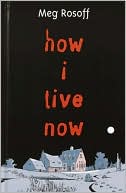
How I Live Now by Meg Rosoff: Book Cover

Rossoff, Meg.  how i live now.  New York:  Random House Children's Books, 2004.  Print.


Annotation: 


Over the course of a year, living overseas during a war, Daisy learns the lessons of love and survival, as she is faced with grown-up realities.


Justification for Nomination:

how I live now is a coming of age story of Daisy, a 15-year-old, American girl sent to England to live on a farm with her Aunt Penn and cousins: 14-year-old twins, Edmond and Isaac, 12-year-old, Osbert, and 9-year-old, Piper. The story is told by Daisy, from her point of view. The story begins slowly, but is deliberate and progressively builds towards something major. While Aunt Penn is out of the country on business, a war breaks out, leaving the children to fend for themselves. Being children, there is not a sense of fear or urgency that would normally be associated with the outbreak of war. They spend their days swimming, playing, walking to town, and sleeping. Edmond and Daisy fall in love with one another and begin a romantic relationship. Eventually, the children are found out by an adult and they are separated – Daisy and Piper are sent to live with a family, while the boys stay on the farm with a group of army men. For the duration of the story, Daisy is ultimately fighting to protect Piper and keep her safe, all the while plotting to get back to Edmond somehow.


An aspect of the book I found really interesting was the blurring of when exactly the story takes place. References to the Internet, emails, cell phones, and texting are prevalent, but then the jarring references to shell shock, the outbreak of smallpox, food rationing, and intermittent communication, makes the reader associate those things with both of the World Wars. The 100% certainty of when the book is taking place is mysterious and alluring.

It should be noted that the book does contain very real, adult issues that some readers (or parents of the readers) may find inappropriate for young adults; specifically, incest and graphic violence. First, Daisy and Edmond fall in love and engage in a romantic relationship. It is not clear if the characters partake in a sexual relationship, but it is clear the cousins are romantically involved with one another.  Second, there are scenes of great violence and horrific imagery. I completed the book last week and as I write this review, days later, two disturbing scenes are immediately brought to mind. Those scenes possibly could be too much for a young adult to handle.

Despite these adult topics, I nominate how I live now because of its intensity and unique plotline. Perhaps it may be inappropriate for the younger YA age range, but I think it is a book which a high school student can handle.  Daisy is a spunky, resilient girl you root for to come out at the other end of the tunnel.

Genre Category:  2005 Michael L. Printz Award Winner (Coming of Age)