Monday, June 13, 2011

3. If I Stay


Forman, Gayle.  If I Stay. New York:  Penguin Book, 2009. Print.


Annotation:

“Dying is easy.  Living is hard.”  In a fraction of a second, everything changes for seventeen-year- old, Mia.  She is in a car wreck with her parents and brother, but has no recollection of the accident happening.  Next she’s in the hospital watching herself be worked on by doctors.  Mia is stuck in a realm of living and dying, and she must make the ultimate choice: do I stay? 


Justification for Nomination:


If I Stay beings with: “Everyone thinks it was because of the snow.  And in a way, I supposed that’s true.”  The tone is set and the story begins immediately by drawing the reader in by those two short sentences.   We’re introduced to Mia and her family and the structure of their relationship with one another is clear – they’re an ordinary family who simply love one another.  The family is home from school on account that it snowed that morning.  They decide to take a drive to the grandparents.  Their car is slammed into by another vehicle.  Mia recalls nothing of the accident.  One moment she’s in the car with her family, the next she’s standing outside the mangled car, seeing for herself that her parents are dead.  It isn’t until she sees a hand sticking out of the wreck that she realizes that is her.  “Am I dead?  I actually have to ask myself this.  Am I dead.  She soon realizes that no, she’s not dead, but she’s badly hurt.  She watches as her severely injured body is loaded into a helicopter to b taken to the hospital.    

If I Stay takes place over the course of 24 hours.  The story is broken into long chapters, each beginning with irregular times – 8:12 p.m., 9:06 p.m., 2:42 a.m.  The breakdown of the chapters is almost like the clicking down to Mia’s ultimate decision.  The crux of the story is the flashbacks Mia has regarding the people in her life she has relationships with:  mother, father, brother, boyfriend, best friend, Gran and Gramps.  Gayle Forman’s writing of these flashbacks showcases just how hard Mia’s decision is and the inner turmoil she is experiencing.  Once Mia understands she is now essentially an orphan, she is faced with making her own major decision.  Does she stay and live a life with her surviving family of grandparents, aunts, uncles, cousins, boyfriend, and best friend?  Or, can she not bear to live a life without her parents and Teddy?   Mia is caught between this in-between world by herself.  She can’t rely on her best friend, or her mom, or her boyfriend to help her.  She must find this on her own. 

In the end, Mia makes the decision that is right for her.  If I Stay is so much more than a YA book.  It transcends age and as an adult reading this, I related to Mia.  I felt Mia’s confusion and fear.  In the flashbacks, I could feel her love and respect she had towards her parents.  I could feel the girlfriend-bond she had with her best friend.  And finally, I could feel the soul connection she had with her boyfriend.  As I read the last three or four pages, tears were rolling down my cheeks.  It made me want to be seventeen again and have Mia’s boyfriend as my boyfriend!  Great, great, fantastic book.

Genre Category:  Coming of Age

Tuesday, June 7, 2011

2. Persepolis: The Story of a Childhood

Satrapi, Marjane. Persepolis. New York: Pantheon Books, 2003. Print.


Annotation:

Gross horrors abound in this graphic novel of growing up in Iran: Islamic fundamentalists, war, arrests, bombings, riots, and death. All told, through the eyes of a young girl, from age 6 to 14.


Justification for Nomination:

Marjane Satrapi’s graphic novel, Persepolis, is a complex and beautifully written and illustrated memoir about her life growing up in Iran. Marjane is a plucky, rebellious and precocious girl and tells her story firsthand with wit, sarcasm, rebellion.

Persepolis is simplistically, but powerfully, illustrated without the use of any color. The illustrations are entirely in black and white, laid out in a comic book format. The story is fast paced using small panels, helping to move the story along quickly and easily. There is the occasional panel which will encompass the entire page, causing the reader to pause and reflect and really delve into the illustration. Satrapi’s style of illustration is childlike and innocent in its simplicity, which suits a story told by a young narrator. The illustrations and text cohesively tell the story and evoke emotions – both through the characters in Persepolis to the reader herself. The illustrations communicate an almost stronger feeling of these emotions – much better than the words may.
What makes Persepolis so astonishing and worthy of a nomination is the fact that Marjane’s story is quite ordinary once you remove the Islamic Revolution and war between Iran and Iraq. Marjane must hide behind her veil in public, but remove that, and what you have left is a young girl living an adolescent life of painting her fingernails, wearing jewelry and Nikes, listening to punk music, hanging a poster of Iron Maiden on her wall, and sneaking cigarettes. These experiments are reminiscent of an American teenage life. The only difference between Marjane’s experience and American teenagers was that we did not have to hide our painted fingernails, our music, or our Nikes. We did not encounter bombings or fear the phone ringing meant somebody close to us had been killed. When we left the house wearing our Nikes, we did not have to fear interrogation by fundamentalist. Persepolis is universally appealing to teenagers all over the world.
It’s hard not to root for, laugh with, cry with, and even love Marjane. Truly an unforgettable girl.
Genre Category: Graphic Novel, Coming of Age, Realistic/Edgy, Multicultural, Memoir

Monday, May 23, 2011

1. how i live now

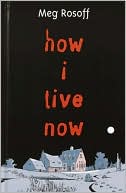
How I Live Now by Meg Rosoff: Book Cover

Rossoff, Meg.  how i live now.  New York:  Random House Children's Books, 2004.  Print.


Annotation: 


Over the course of a year, living overseas during a war, Daisy learns the lessons of love and survival, as she is faced with grown-up realities.


Justification for Nomination:

how I live now is a coming of age story of Daisy, a 15-year-old, American girl sent to England to live on a farm with her Aunt Penn and cousins: 14-year-old twins, Edmond and Isaac, 12-year-old, Osbert, and 9-year-old, Piper. The story is told by Daisy, from her point of view. The story begins slowly, but is deliberate and progressively builds towards something major. While Aunt Penn is out of the country on business, a war breaks out, leaving the children to fend for themselves. Being children, there is not a sense of fear or urgency that would normally be associated with the outbreak of war. They spend their days swimming, playing, walking to town, and sleeping. Edmond and Daisy fall in love with one another and begin a romantic relationship. Eventually, the children are found out by an adult and they are separated – Daisy and Piper are sent to live with a family, while the boys stay on the farm with a group of army men. For the duration of the story, Daisy is ultimately fighting to protect Piper and keep her safe, all the while plotting to get back to Edmond somehow.


An aspect of the book I found really interesting was the blurring of when exactly the story takes place. References to the Internet, emails, cell phones, and texting are prevalent, but then the jarring references to shell shock, the outbreak of smallpox, food rationing, and intermittent communication, makes the reader associate those things with both of the World Wars. The 100% certainty of when the book is taking place is mysterious and alluring.

It should be noted that the book does contain very real, adult issues that some readers (or parents of the readers) may find inappropriate for young adults; specifically, incest and graphic violence. First, Daisy and Edmond fall in love and engage in a romantic relationship. It is not clear if the characters partake in a sexual relationship, but it is clear the cousins are romantically involved with one another.  Second, there are scenes of great violence and horrific imagery. I completed the book last week and as I write this review, days later, two disturbing scenes are immediately brought to mind. Those scenes possibly could be too much for a young adult to handle.

Despite these adult topics, I nominate how I live now because of its intensity and unique plotline. Perhaps it may be inappropriate for the younger YA age range, but I think it is a book which a high school student can handle.  Daisy is a spunky, resilient girl you root for to come out at the other end of the tunnel.

Genre Category:  2005 Michael L. Printz Award Winner (Coming of Age)